Tuesday, May 5, 2015

3-D haptic shapes can be seen and felt in mid-air


New research, using ultrasound, has developed a 3-D haptic shape that can be seen and felt in mid-air.
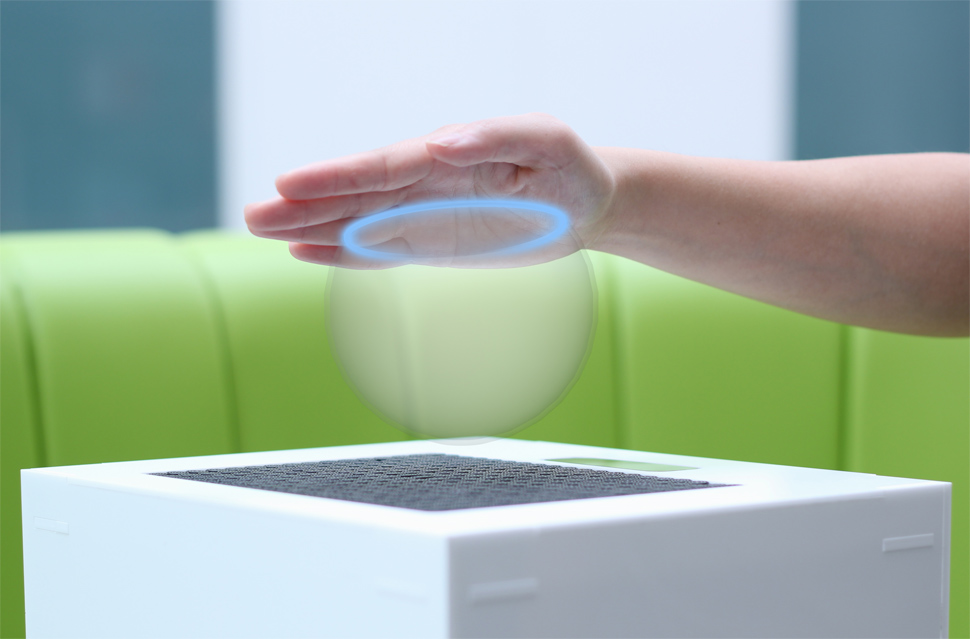


Touch feedback technology – known as haptics – has advanced rapidly in recent years. It is now used in a range of applications including entertainment, rehabilitation and even surgical training. New research by the University of Bristol, using ultrasound, has created a virtual 3-D haptic shape that can be seen and felt in mid-air.
This breakthrough, led by Dr Ben Long and colleagues at the university's Department of Computer Science, could improve the way 3-D shapes are used and function as an important new tool in certain situations. It could enable surgeons to explore a CT scan, for example, by enabling them to actually "feel" a disease, such as a tumour.
The method uses ultrasound, focussed onto hands above the device and can be felt. By focussing complex patterns of ultrasound, the air disturbances can be seen as floating 3-D shapes. Visually, the researchers have demonstrated the ultrasound patterns by directing the device at a thin layer of oil so that the depressions in the surface can be seen as spots when lit by a lamp.
The system generates a virtual 3-D shape that can be added to 3-D displays to create a holographic effect that can be seen and felt. The research team have also shown that users can match a picture of a 3-D shape to the shape created by the system. They have already been approached by companies interested in commercialising the technology. At this early stage of development, the level of detail in the virtual objects is limited, but using a greater number of speakers at smaller sizes could improve the resolution of projections.
“Touchable holograms, immersive virtual reality that you can feel and complex touchable controls in free space, are all possible ways of using this system,” says Dr Long. “In the future, people could feel holograms of objects that would not otherwise be touchable, such as feeling the differences between materials in a CT scan or understanding the shapes of artefacts in a museum.”

Microsoft offers a close look at HoloLens hardware


We talked quite a bit about the Microsoft HoloLens goggles yesterday. We took a bit of a look at the hardware inside the headset and liked the fact that the HoloLens needed no wires to work. HoloLens is a headset that will support Windows 10 applications running directly inside the device.

The apps will need to be optimized for HoloLens, and if they are you can run them directly on the headset just as you could on a Windows 10 PC. Microsoft has posted a video that shows a bit of how the HoloLens is made along with some of the things it will do.
The portion of the video showing the glasses laying data over items in the real world is very cool. The video looks at the audio aspects of the headset and how it fits on the head.
To say the HoloLens is packed with sensors is an understatement. The big downside that I see with the HoloLens right now is that it is big and bulky. I can’t see people wearing these things without feeling self-conscious about it. Perhaps in the future the HoloLens will get smaller.

THERE’S A BRIGHT IDEA: AUDI WORKING TO COMBINE MATRIX-BEAM HEADLAMPS WITH LASER LIGHTS

Audi Laser / Matrix Headlights

Leave it to Audi to make headlights something interesting to talk about. Not satisfied with their laser light technology, they’re hard at work incorporating that with the matrix-beam system they demonstrated working with LED lighting.
To bring you up to speed, the matrix lighting maps out a grid for the headlight beam area. Instead of shutting off or redirecting the whole beam, the LED tech can simply turn off the light in a section where the light might be blinding. In practical terms, if the car detected an oncoming vehicle, it would still brightly illuminate the dark path in front of the car and just switch off the part of the beam where another vehicle was traveling.
Audi Laser / Matrix Headlights
Getting this to work with its laser light tech isn’t a matter of just swapping out the light source. Laser light tends to be more direct and intense, so the solution Audi has been working on revolves around a system called the Intelligent Laser Light For Compact and High-Resolution Adaptive Headlights.

It just rolls off the tongue, doesn’t it? Mercifully called iLas for short, the system utilizes a rapidly moving micro-mirror that redirects the laser beam. When traveling at low speeds, light is projected in a larger area and narrowed through an aperture when traveling fast on the highway. This gives Audi drivers the best of both worlds: intense, clean beams of light that can illuminate far in front of them, coupled with the fluid dynamics of the LED-matrix system.

NASA's 10-engine electric UAV now flies as well as it hovers


NASA's ten-engine UAV, dubbed the Greased Lightning (GL-10), recently showed off a slick new trick in the skies over Hampton, Virginia. The drone, which is under development by a team at the Langley Research Center, had already passed its initial hovering tests last August; but that was the easy part. As the long and miserable development of the V-22 Osprey has shown, the real challenge is switching over from hover mode to conventional forward flight without the vehicle falling out of the sky. But on Thursday, NASA's battery-powered tilt-rotor aircraft successfully did just that.

"During the flight tests we successfully transitioned from hover to wing-borne flight like a conventional airplane then back to hover again. So far we have done this on five flights," aerospace engineer Bill Fredericks said in a statement. "We were ecstatic. Now we're working on our second goal -- to demonstrate that this concept is four times more aerodynamically efficient in cruise than a helicopter."
Should the GL-10 prove its aerodynamic ability, the Langley team hopes to spin the technology off into a number of commercial applications including small package delivery (put your hand down, Amazon) or industrial/agricultural surveillance. And as Fredericks continued, "a scaled up version--much larger than what we are testing now--would make also a great one to four person size personal air vehicle."

Warby Parker wants you to use your phone for eye exams

Warby Parker's Holiday Spectacle Bazaar Launch Party
Warby Parker, the eyewear company that sends you frames to try on before you make a purchase, has some lofty goals for the near future. In addition to plans that'll almost double its current retail footprint, the start-up has tech in the works that will save you a trip to the optometrist for an eye exam. "We think that would increase access to eye exams," co-founder Dave Gilboa told The Wall Street Journal. "It's early in the process but we are excited about the potential." Of course, besides the convenience, it'll also provide an avenue for folks who really need their eyes looked at to get some help at home.
Both the new stores and the software project will get a boost from Warby Parker's recent $1.2 billion valuation, coming on the heels of a funding round that took in $100 million. The company started as a web business that ships a box frames for eager shoppers try on at home before having a pair made with the proper prescription. In 2013, it beganopening physical stores, now totaling 12 locations in 9 cities around the US.
Update: A previous version of this article stated that Warby Parker was working on an app for eye exams; however, the company is working on technology to make those possible with a smartphone. The most recent round of funding was $100 million, not $215 -- that's the total raised so far. The text has been updated to correct the inaccuracies.

Everything You Need to Know About Tesla's New Household Batteries

Everything You Need to Know About Tesla's New Household Batteries

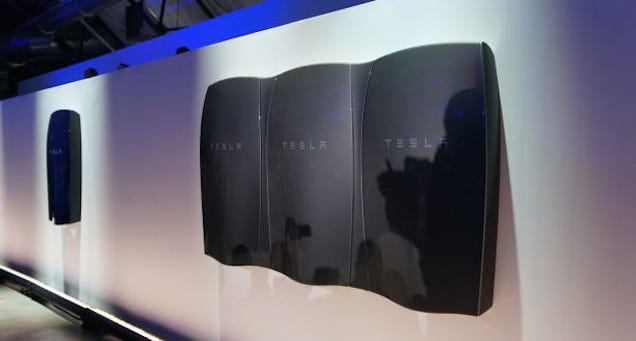
Tesla unveiled a new product line at its design studio in LA tonight. It’s called Tesla Energy and it’s a suite of batteries for homes and for businesses. The existence of the batteries has been one of the worst kept secrets of all time. But we are here at the announcement event and finally have some details. And they’re pretty damn cool.
“Our goal is to fundamentally change the way the world uses energy,” Elon Musk said in a pre-event briefing with the press. “Which sounds crazy.”
It does sound crazy. But that’s the business Musk seems to have gotten himself into.

What are they?

The home battery is called the Powerwall. The business-targeted battery is called the Powerpack. They’re “completely sustainable, zero carbon,” as Musk puts it.
The Powerwall increases the capacity for a house with solar panels, but can also be used during power outages. It can fit on the wall in your garage—to power your Tesla, of course—or the outside wall of your house. It’s about 3 feet across, 4 ft tall, and 6 inches deep. It comes with a 10 year warranty.
It’s connected to the internet so it’s constantly talking to Tesla Energy and monitoring usage.

How much do they cost?

Tesla’s selling price to installers is $3500 for 10kWh and $3000 for 7kWh.
Business battery prices haven’t been made public as of yet.
Everything You Need to Know About Tesla's New Household Batteries

How do they get installed?

“We’re working with certified installers for the Powerwall,” Musk said. “It’s designed to be easy to install, with two people in maybe a half an hour to an hour.”

When can I get one?

You can order the Tesla Powerwall battery now online but they’re not slated for release until late summer. The Powerpack (business version) will start to become available later this year. They’ll be making a larger push with businesses in 2016.
But that being said, they’re already out in the real world. The company partnered with SolarCity for a pilot project in California that supplied roughly 300 homes with the batteries. About a dozen Walmart stores in California and a Cargill animal processing plant have the business-grade batteries and have been testing those as well.
Tesla Energy plans to be in Germany and Australia by the end of the year. He also sees potential uses in developing countries with little access to reliable power. “In a lot of places there are no utility lines,” Musk said.
Everything You Need to Know About Tesla's New Household Batteries

Is Musk using them at his home?

Yes, but he’s not going to be able to go completely off the grid soon.
“My house doesn’t have quite the right roof to generate enough solar power to go off the grid,” Musk said before the event. “I think it’ll probably be 2/3 solar power when it’s all said and done.”

Why does any of this matter?

By pulling homes and businesses off the grid during peak hours, America’s electrical infrastructure would see greater stability. With enough people on board (and critical mass of adoption is obviously a ways into the future) we’d likely see fewer brownouts in our cities.
Another attractive part for consumers is that this kind of battery will give homeowners complete energy independence, allowing them to sever connections to utility companies.

What are the specs for the home version?

  • Energy: 7kWh or 10kWh
  • Continuous Power: 2kW
  • Peak Power: 3kW
  • Round Trip Efficiency: >92%
  • Operating Temperature Range: -20C (-4F) to 43C (110F)
  • Dimensions: H: 1300mm W: 860mm D:180mm

HP revamps PCs: Is it really year of the desktop?

hp-pavilion-desktops4-new-colors.png

Hewlett-Packard on Monday rolled out a series of systems in what one exec calls "the year of the desktop."
Desktop?!?
Mike Nash, vice president of portfolio strategy and customer experience at HP, acknowledged that the desktop has been given short-shrift amid other priorities such as laptops, convertibles and tablets, but now it's time for an overhaul.
And it's hard to argue against the idea that the desktop should get some design love.
HP's update to its desktop lineup is similar to the refresh last month that revolved around laptops.
Not surprisingly, HP's first wave revolved around the Pavilion all-in-ones, a popular form factor. The latest Pavilions come with a glass HD display from edge to edge, access to ports along the bottom edge of the screen and less frequently access cables in the back, a selection of Intel or AMD processors and screens varying from 21 inches to 27 inches.
The all-in-ones also can carry up to 16GB of memory and 3TB hard drives.
But the real desktop focus comes with what HP calls a "vertical design language" and color options ranging from white to silver to blue and red with Pavilion desktops. Like the all-in-ones, there's a selection of Intel or AMD chips as well as integrated optical drives and up to 3TB of storage.
HP also rolled out the Envy desktop, which is brushed aluminum, has a selection of AMD and Intel chips with a 3TB drive or 512GB solid state drive. The desktop will also support high-end video and photo editing.
And finally, HP highlighted the Envy Phoenix desktop, which is a dark brushed aluminum system that allows gamers to over clock processors from Intel. The system also includes a thermal system with closed loop liquid cooling and a 4TB drive or 128GB or 512GB solid state drive. Graphics chips are available from both Nvidia and AMD.
hp-envy-phoenix-desktopfront-facing.jpg
HP Envy Phoenix
The availability and pricing details break down like this:
  • The 21.5- and 23-inch HP Pavilion all-in-one PCs will be available on June 28 on HP's site starting at $649.99 and $699.99, respectively.
  • The HP Pavilion, ENVY and ENVY Phoenix towers will be available on June 10 on HP's site. The HP ENVY tower starts at $699.99 with the HP ENVY tower starting at $899.99. The Pavilion desktop will start at $499.99 at retailers.